Insights from the Fintech Panel at Brimstone Melbourne 2026
Financial advice is changing fast.
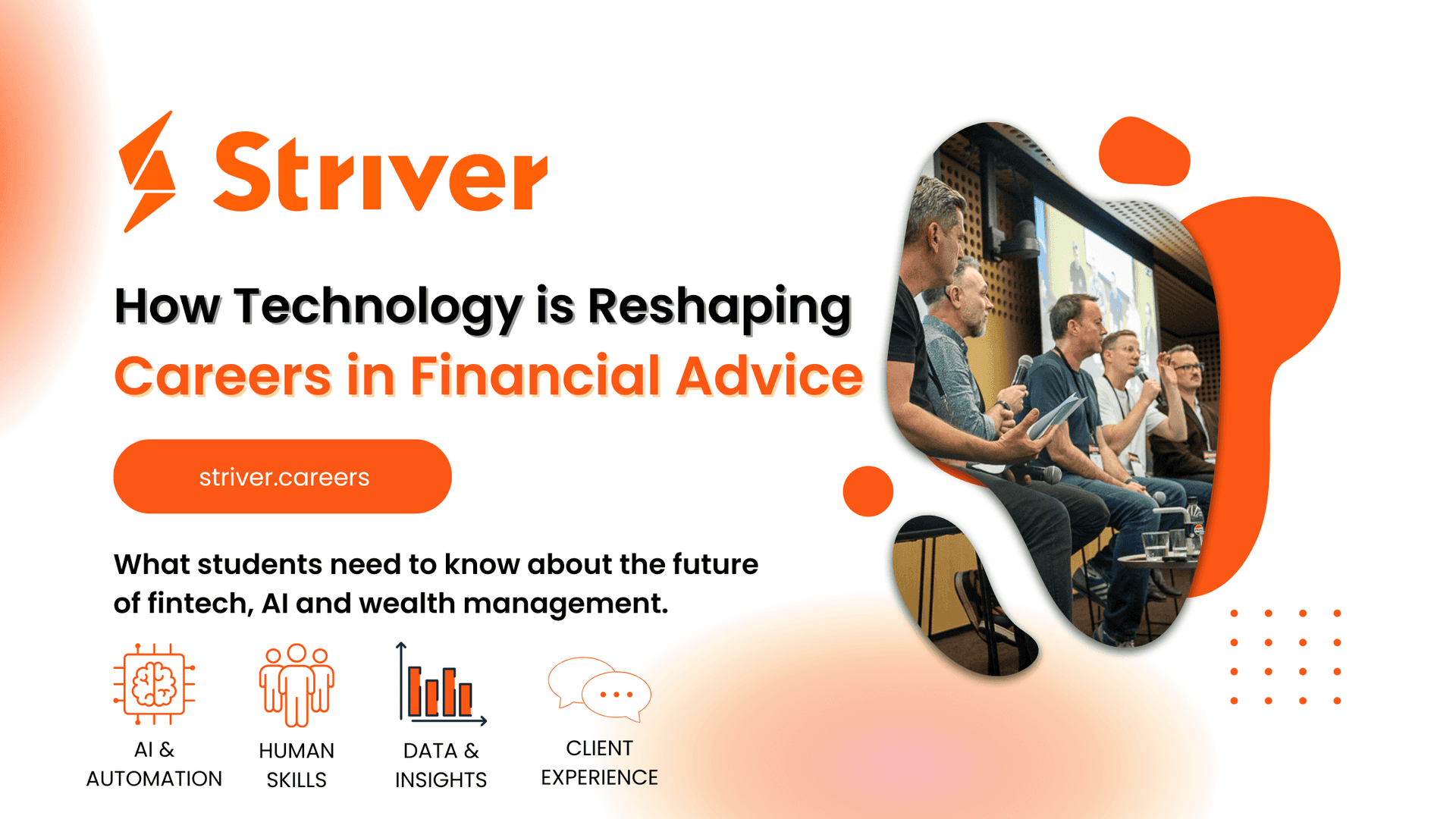
That was the underlying message from the Fintech Panel at Brimstone Melbourne 2026, hosted by Striver’s CEO, Alisdair Barr, and featuring:
- Daniel Sinfield (Senior Emerging Technology Analyst at UniSuper)
- Mike Bridgford (Head of Industry Programs at Iress)
- Paul Feeney (Founder of Otivo)
- Angus Woods (Managing Director at Adviser Ratings)
But if you are a student thinking about entering this space, the real question is not what was said on stage.
It is this: What will this industry actually look like by the time you graduate and start working in it?
You are not entering a “stable” industry, you are entering a system being rebuilt
One of the clearest themes was that financial advice is still in a transition phase.
Right now, around 11.8 million Australians have unmet financial advice needs, while only about 2 million people actually receive advice each year.
That gap is not just a statistic. It is the reason the entire industry is being rebuilt.
What that means for you is simple. You are not joining a finished system. You are joining a system that is actively trying to figure out how to scale advice to more people without losing trust, quality or regulation.
So your career will not be about working inside how advice has always been done. It will be about helping redesign how advice gets delivered.
AI is not something you will “learn later”, it will already be in your job
AI is not being discussed as a future concept. It is discussed as current infrastructure.
Already today, it is being used to:
- reduce admin and repetitive work
- summarise client conversations
- speed up workflows
- help advisers get to insights faster
- improve client experience
But there is also a clear boundary. AI is not replacing financial advisers.
Advice is still regulated, accountable and human-led. A model can assist, but it cannot be responsible for a client outcome.
What this means for you: By the time you enter the industry, you will not be “learning AI tools”.
You will be expected to work in an environment where AI is already everywhere, and your skill will be knowing what still requires human judgement on top of it.
Less time on admin. More time on thinking, interpreting and communicating.
The biggest advantage you can build right now is curiosity
One of the strongest messages from the panel was surprisingly simple.
The most valuable people in this industry are not always the most technical.
They are the most curious.
Noticing how systems connect. Asking better questions. Being willing to explore things you do not fully understand yet.
For students, that translates into:
- actually experimenting with tools instead of just reading about them
- trying small projects or ideas
- asking how different parts of the system fit together
- being comfortable learning in public
Because the reality is, the industry you enter will already be different from the one you study.
So the advantage is not knowing everything.
It is being able to adapt faster than the environment changes.
Communication will still decide how far you go
Even with AI and automation, financial advice is still a people industry.
The technical side is important, but the human side is what builds trust.
The best people in this space will still be the ones who can:
- explain complex ideas simply
- understand what someone actually cares about
- build trust quickly
- guide people through uncertainty
That is not something automation replaces.
One of the clearest pieces of advice from the panel was simple:
Talk to people. Early. Often.
Because in this industry, your ability to communicate is not a soft skill. It is the core skill.
You are not choosing one job, you are choosing an ecosystem
A common misconception is that financial services equals becoming a financial adviser.
That is only one part of it.
The industry actually includes a much wider set of paths:
- fintech and digital advice
- AI and automation
- cybersecurity and risk
- data and analytics
- product and platform design
- compliance and regulation
- investment research
- client experience roles
What this means for you: You do not need to have your entire career mapped out.
You just need to understand the ecosystem you are stepping into, and where your strengths might fit within it.
The best time to start is not after graduation
If there was one consistent takeaway, it was this.
Do not wait until you finish university to start engaging with this space.
Start now.
That might look like:
- experimenting with AI tools like ChatGPT or Claude
- following how fintech companies are changing advice
- learning how financial systems actually work
- talking to people already in the industry
- building small ideas or side projects
One of the simplest lines from the panel summed it up well:
Technology is 50 percent study and 50 percent play.
You learn by doing, not just observing.
Final thought
What came out of the Fintech Panel at Brimstone Melbourne 2026 was not a story about technology replacing people.
It was a story about how the shape of the work is changing, but the purpose is not.
Financial advice is still about helping people make better decisions with their money.
What changes is how that help is delivered, at scale, with the support of technology.
For students entering financial advice, wealth management or fintech, the opportunity is not just to participate in that change.
It is to help build it.
And the people who will do well are not necessarily the ones who know the most today.
They are the ones who are willing to learn as the industry keeps moving.
